
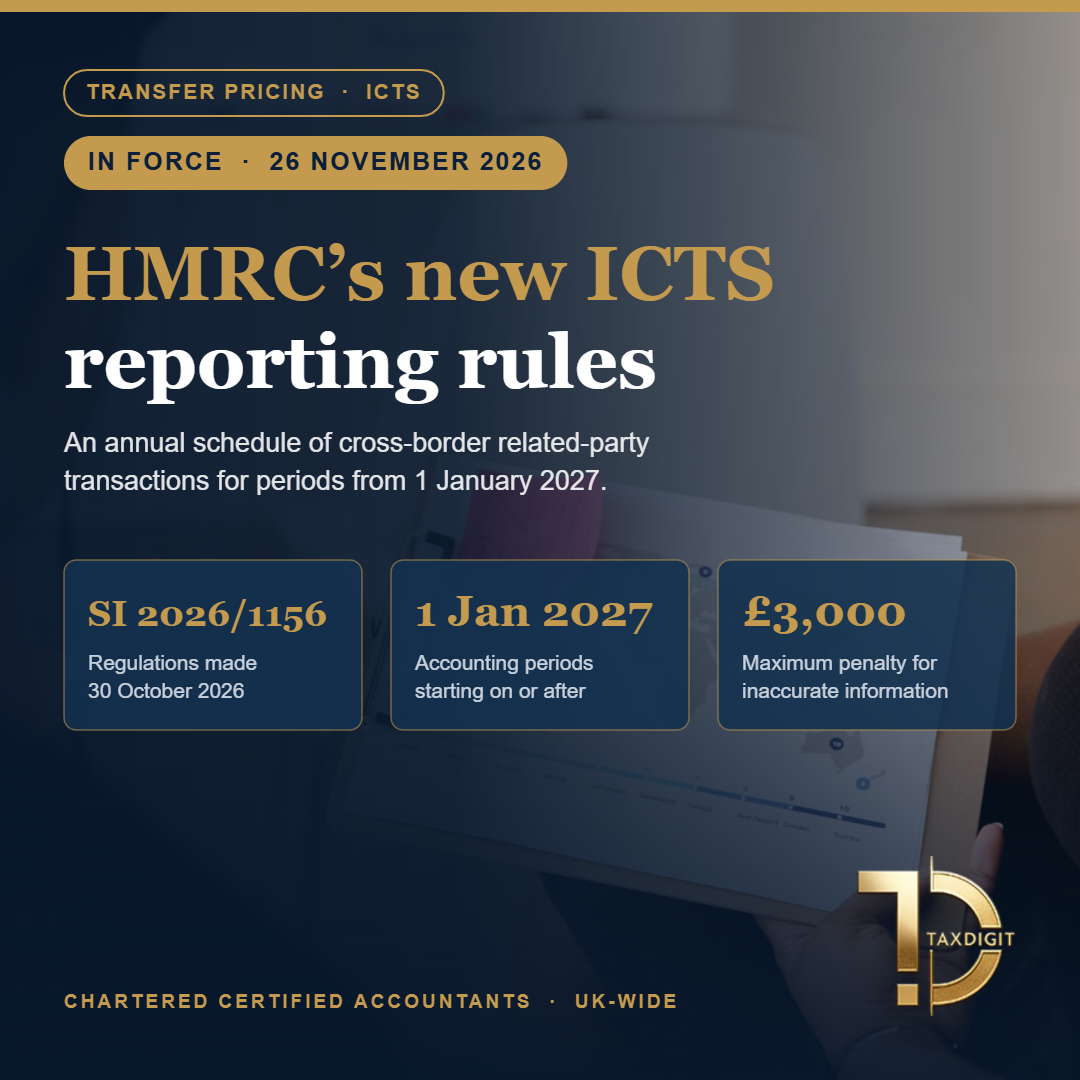
In short: HMRC’s new International Controlled Transactions Schedule (ICTS) becomes law on 26 November 2026, when the International Controlled Transaction Reporting Regulations 2026 (SI 2026/1156) come into force. The rules apply to accounting periods beginning on or after 1 January 2027, so a UK company with a 31 December year end will prepare its first schedule for the year to 31 December 2027 and file it by 31 December 2028. HMRC aims to publish the notice that sets the reporting thresholds on the same day, 26 November 2026. TaxDigit, chartered certified accountants advising UK companies and overseas groups across the UK, explains who must report, the deadlines and penalties, and what to do before 1 January.
What is the ICTS, and why it matters
The ICTS is a new annual report to HMRC of specified cross-border transactions between connected parties: goods, services, management charges, royalties, intra-group loans and similar dealings between a UK company and related companies abroad. It also covers dealings that affect the profits of a UK permanent establishment of an overseas company. The legal power comes from section 48 of the Finance Act 2026, and the detail sits in SI 2026/1156.
HMRC says the aim is to support more accurate identification of transfer pricing and permanent establishment risk, using the data for automated risk profiling as well as manual review (HMRC International Manual, INTM917320). In practice, HMRC will see transaction-level data for the first time, before it opens any enquiry.
What changes from 26 November 2026
- The Regulations were made on 30 October 2026, laid before the House of Commons on 4 November 2026 and come into force on 26 November 2026.
- They apply to accounting periods beginning on or after 1 January 2027.
- HMRC aims to publish the ICTS notice on 26 November 2026. The notice sets the thresholds, the information to be reported for each transaction and the aggregation rules.
- HMRC plans detailed guidance in its International Manual by 31 December 2026.
- The reporting entity is usually the UK resident company that is party to the transaction. A non-UK resident company with a UK permanent establishment, and the representative partner of a partnership, can also be required to report.
Deadlines and penalties at a glance
| Situation | ICTS filing deadline | Source |
|---|---|---|
| Accounting period ending on or before 30 September 2027 | The later of 30 September 2028 and the date given in HMRC’s notice | SI 2026/1156, reg. 6(1)(a) |
| Accounting period ending after 30 September 2027 | The date the company tax return for that period is due | SI 2026/1156, reg. 6(1)(b) |
| Example: year ending 31 December 2027 | 31 December 2028 (12 months after the period end) | SI 2026/1156, reg. 6(1)(b) |
The penalties are set out in the Regulations: £300 for each accounting period where the required information is not provided (reg. 19), daily penalties of up to £60 if the failure continues (reg. 20), which the tribunal can increase to up to £1,000 a day (reg. 26), and up to £3,000 for inaccurate information (reg. 21).
The catch: the thresholds arrive with HMRC’s notice
The Regulations do not set the reporting threshold themselves. A transaction is only reportable once it meets the threshold in HMRC’s notice, so the notice due on 26 November 2026 decides how many of your transactions are caught. The Regulations also contain exceptions, including for charities and companies wholly owned by a charity. Baker McKenzie’s review of the Regulations also points to exceptions for transactions covered by the SME exemption from UK transfer pricing, distributions, certain dormant companies and transactions covered by an advance pricing agreement. Until the notice is out, the safe working assumption is that a group with material cross-border related-party transactions is in scope.
Who should pay attention
- UK subsidiaries of overseas groups paying management fees, royalties or interest to a parent or sister company abroad.
- UK groups with overseas subsidiaries or branches selling goods or services within the group.
- Overseas companies with a UK permanent establishment, for dealings between the UK branch and head office.
- Groups already preparing a Master File, Local File or country-by-country report: the ICTS adds transaction-level data, and the figures need to agree with your documentation.
What UK companies should do now
- List every cross-border transaction with connected parties that will fall in accounting periods starting on or after 1 January 2027.
- Check that your accounting system can capture, for each transaction, the counterparty, its country, the transaction type, the value and the transfer pricing method.
- Read HMRC’s notice when it is published and test your transactions against the thresholds.
- Line up your ICTS data with your transfer pricing documentation and intercompany agreements, so HMRC sees one consistent story.
- Put the ICTS deadline in the diary next to your CT600 deadline, and plan who owns the data in each group company.
Frequently asked questions
When do the ICTS rules start?
The Regulations come into force on 26 November 2026 and apply to accounting periods beginning on or after 1 January 2027. Source: SI 2026/1156, regulation 1.
When is the first ICTS due?
For a company with a 31 December year end, the first period is the year ending 31 December 2027 and the schedule is due by 31 December 2028, the same date as the company tax return. For periods ending on or before 30 September 2027, the deadline is the later of 30 September 2028 and the date in HMRC’s notice.
Does the ICTS apply to small companies?
Only transactions that meet the threshold in HMRC’s notice are reportable, and commentators note that transactions covered by the SME exemption from UK transfer pricing are excepted. Check your position once the notice is published.
What are the penalties for getting it wrong?
£300 for each accounting period where information is not provided, daily penalties of up to £60 (up to £1,000 a day if the tribunal increases them), and up to £3,000 for inaccurate information.
How TaxDigit can help
We help UK subsidiaries of overseas groups and UK groups with foreign operations get ready for the ICTS: mapping intercompany transactions, testing them against HMRC’s thresholds and preparing the annual schedule. See our ICTS service, our transfer pricing documentation work, our support for large and multinational groups, Pillar Two and country-by-country reporting. Overseas companies setting up in the UK can start with our UK business expansion page. The Regulations are on legislation.gov.uk (SI 2026/1156).
Plan ahead with TaxDigit
If your company has cross-border transactions with group companies, now is the time to check whether the ICTS applies and what data you will need from 1 January 2027. Call us on 01483 230 777, email info@taxdigit.co.uk or get in touch online. We work in English, with translated pages available for clients from many countries.