
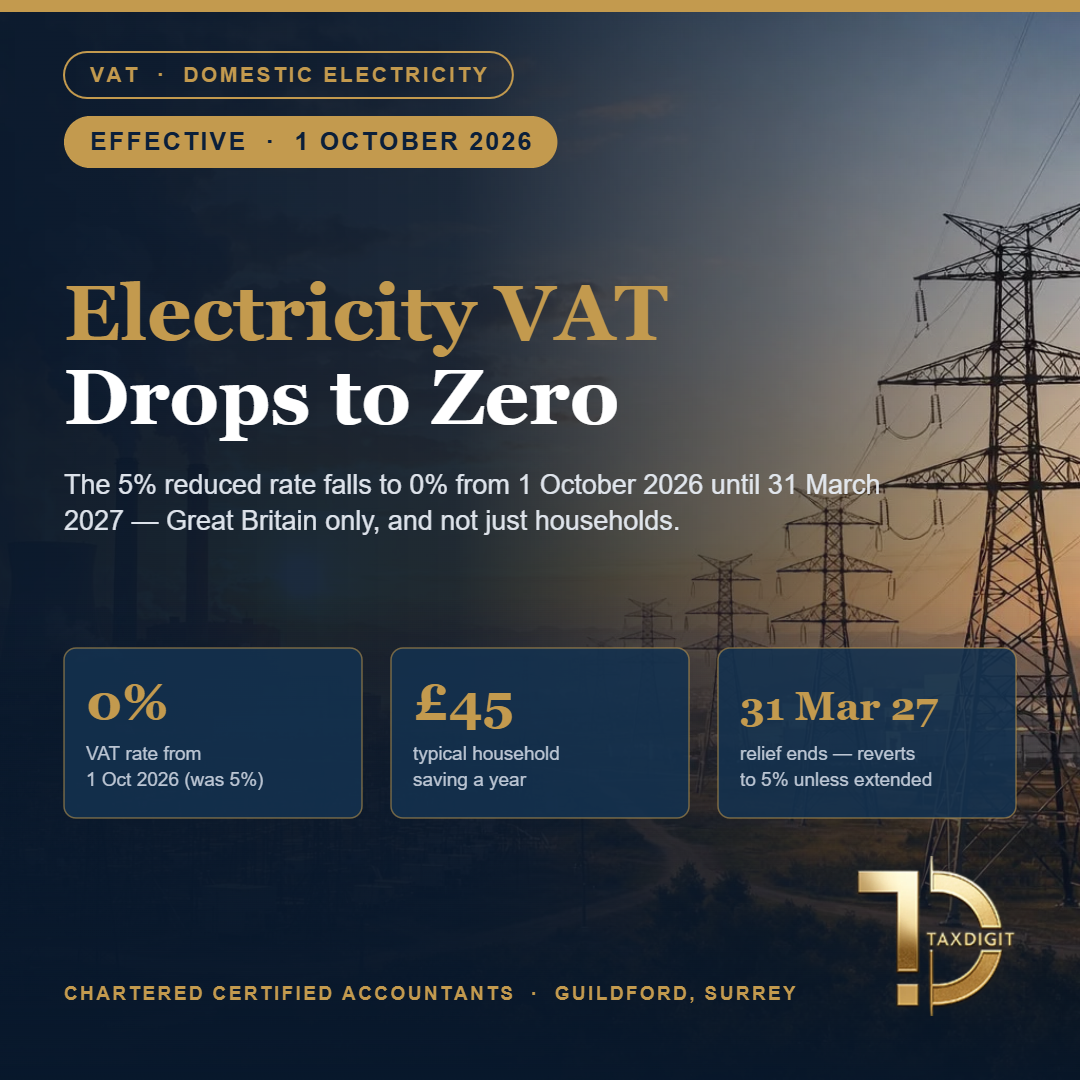
A five per cent rate falls to nil — from 1 October 2026 until 31 March 2027, VAT on qualifying supplies of domestic electricity in Great Britain drops from the 5% reduced rate to 0%, worth around £45 a year to a typical household and £850 million to the Exchequer in 2026-27. As chartered certified accountants in Surrey advising households, charities, care providers and owner-managed businesses across the UK, TaxDigit explains who actually qualifies — because this is not a households-only measure — and where the two dates create traps on either side of the relief.
What the Reduced Rate Covers — and Why It Matters
VAT on fuel and power is not a single rate. Most commercial supplies carry 20%, but Group 1 of Schedule 7A to the Value Added Tax Act 1994 charges 5% where the supply is for qualifying use. Qualifying use means two things: domestic use, and use by a charity for its non-business activities.
Domestic use is far wider than “a house”. It takes in flats and dwellings, caravans and houseboats, children’s homes and homes providing care for the elderly or disabled, student halls of residence, armed forces accommodation and self-catering holiday accommodation. Hotels, prisons and hospitals are excluded. There is also a de minimis rule: a supply of electricity averaging no more than 33 kilowatt hours a day — 1,000 kWh a month — to one customer at one set of premises is treated as domestic whatever it is actually used for. That sweeps in a large number of small shops, salons, workshops, consulting rooms and village halls. Where premises are mixed, the 60% rule applies: if at least 60% of the supply is qualifying use, the whole supply takes the lower rate; below that, it is apportioned.
What Changes From 1 October 2026
The cut was announced on 21 July 2026 and is timed to land before the next Ofgem price cap, so the saving shows in the cap rather than being absorbed on the way through.
- The 5% reduced rate on qualifying supplies of electricity becomes 0% for supplies made on or after 1 October 2026.
- The relief runs to 31 March 2027 and reverts to 5% from 1 April 2027 unless it is extended at the Autumn Budget.
- It is electricity only. Gas, heating oil, LPG, coal and supplies of heat, steam, ventilation and air conditioning remain at 5% where they qualify.
- It applies in Great Britain only. Under the Windsor Framework, Northern Ireland remains subject to EU VAT rules and cannot take on a new zero rate; the Northern Ireland Executive receives comparable funding to provide equivalent support instead.
- The cost is put at £850 million in 2026-27, funded by cancelling the £1.8 billion Digital ID programme, and is expected to take around 0.10 percentage points off CPI.
Crucially, the announcement does not change who qualifies. It changes only the rate charged on supplies that already qualify for the reduced rate today. Draft legislation had not been published when this article went out; the measure is expected to be delivered by Treasury order amending the VAT Act rather than in a Finance Bill.
The Catch — Two Dates, and a Rate Change in Each Direction
VAT on a continuous supply of power falls due at the rate in force at the tax point, which for most energy accounts is the earlier of the invoice date and the date payment is received. That is not the same as the date the electricity was used. Where a rate changes, section 88 of the VAT Act allows a supplier to account instead by reference to when the supply was actually made, and suppliers will normally apportion a billing period straddling 1 October 2026 so that only the part supplied on or after that date is zero-rated. Customers should check the apportionment rather than assume it.
Three points deserve attention. First, a fixed tariff is no protection and no exclusion: the VAT rate is a matter of law, not of contract, so a fixed-price deal should still show 0% from 1 October. Second, advance payments and direct debits taken before 1 October for electricity supplied afterwards create a tax point at 5%, which the supplier should correct. Third, a credit note or rebilling issued after 1 October but relating to electricity supplied before it must carry VAT at 5%, not 0% — a credit follows the rate on the original supply. Every one of these reverses on 1 April 2027, when the rate goes back up.
Who Benefits — and Who Should Still Pay Attention
The saving is only real where the VAT is irrecoverable. A VAT-registered trading business that recovers its input tax in full is neutral: cash flow improves slightly, but cost does not move.
The gainers are those who cannot reclaim. Households. Charities, on their non-business activities. Care homes, hospices and supported housing, whose income is largely VAT exempt so their input tax sticks. Academies, housing associations and NHS staff accommodation. And small unregistered businesses whose electricity sits under the de minimis limit and is therefore charged at the domestic rate. Partly exempt businesses gain to the extent of their restriction.
The group that should pay closest attention is anyone with qualifying premises who has never given their supplier a certificate of qualifying use. Without that certificate the supplier charges 20%, and the zero rate never reaches the bill at all. If the mix of use at a site has drifted above or below the 60% line since the certificate was signed, that needs revisiting too — in either direction.
What Businesses, Charities and Households Should Do Now
- Check the October bill actually shows 0% on qualifying electricity, including on a fixed tariff, and query it with the supplier if it does not.
- Confirm the supplier holds a current certificate of qualifying use for every qualifying site — residential accommodation, care home, charity non-business use or de minimis — and refresh it where the use has changed.
- Look at the invoice covering 1 October 2026 and check the period has been apportioned rather than charged at 5% throughout. Do exactly the same with the invoice covering 1 April 2027.
- Review advance payments, direct debit schedules and any prepayment for electricity to be supplied after 1 October, and make sure the correction comes through.
- Diarise 31 March 2027 and budget on the basis that 5% returns the next day. Treat any extension announced at the Autumn Budget as a bonus, not a plan.
Frequently Asked Questions
Does the 0% rate cover gas as well as electricity?
No. The measure is confined to electricity. Gas, heating oil, LPG, coal and supplies of heat or steam remain at the 5% reduced rate where they are for qualifying use.
Does it apply in Northern Ireland?
No. Northern Ireland remains subject to EU VAT rules under the Windsor Framework and cannot introduce a new zero rate, so domestic electricity there stays at 5%. The Northern Ireland Executive is receiving comparable funding to deliver equivalent cost-of-living support by another route.
My business is not VAT registered and uses very little electricity. Do I benefit?
Very probably. If your electricity at a set of premises averages no more than 33 kWh a day, or 1,000 kWh a month, it is charged at the domestic rate regardless of what it is used for, and that rate becomes 0% from 1 October 2026.
What rate goes on a credit note issued after 1 October for a bill charged at 5%?
5%. A credit note takes the rate of the supply it corrects, not the rate in force when it is issued. The same principle applies in reverse to credits issued after 1 April 2027 for zero-rated supplies made before it.
How TaxDigit Can Help
TaxDigit advises on VAT across the full range of partial exemption, qualifying use and rate-change issues, alongside tax advisory and planning and day-to-day bookkeeping for charities, care providers and owner-managed businesses. We can test whether your premises qualify, draft or refresh the certificate of qualifying use, review the straddling invoices on both sides of the relief and recover VAT charged at the wrong rate. We took the same approach to the recent locum doctor VAT exemption refund window. The underlying reduced-rate provision is at Schedule 7A to the Value Added Tax Act 1994 on legislation.gov.uk.
Plan Ahead With TaxDigit
Six months of relief is easy to miss and easy to get wrong at both ends. If you run qualifying premises — or you are not sure whether you do — it is worth checking before the October bill lands rather than afterwards. Call 01483 230 777, email info@taxdigit.co.uk or book a consultation with our team in Guildford, Surrey.