
There is no comprehensive double taxation agreement between the United Kingdom and Iran. HMRC says so plainly in its own Double Taxation Relief manual, and Iran is one of very few significant economies where that remains true. TaxDigit are chartered certified accountants in Guildford, Surrey, advising Farsi-speaking clients across the UK, and this is the single most misunderstood point we deal with. This article explains what you get instead of treaty relief, why your nationality can decide whether you receive a UK personal allowance at all, and what the four-year regime for new arrivals is really worth.
What “No Treaty” Actually Means
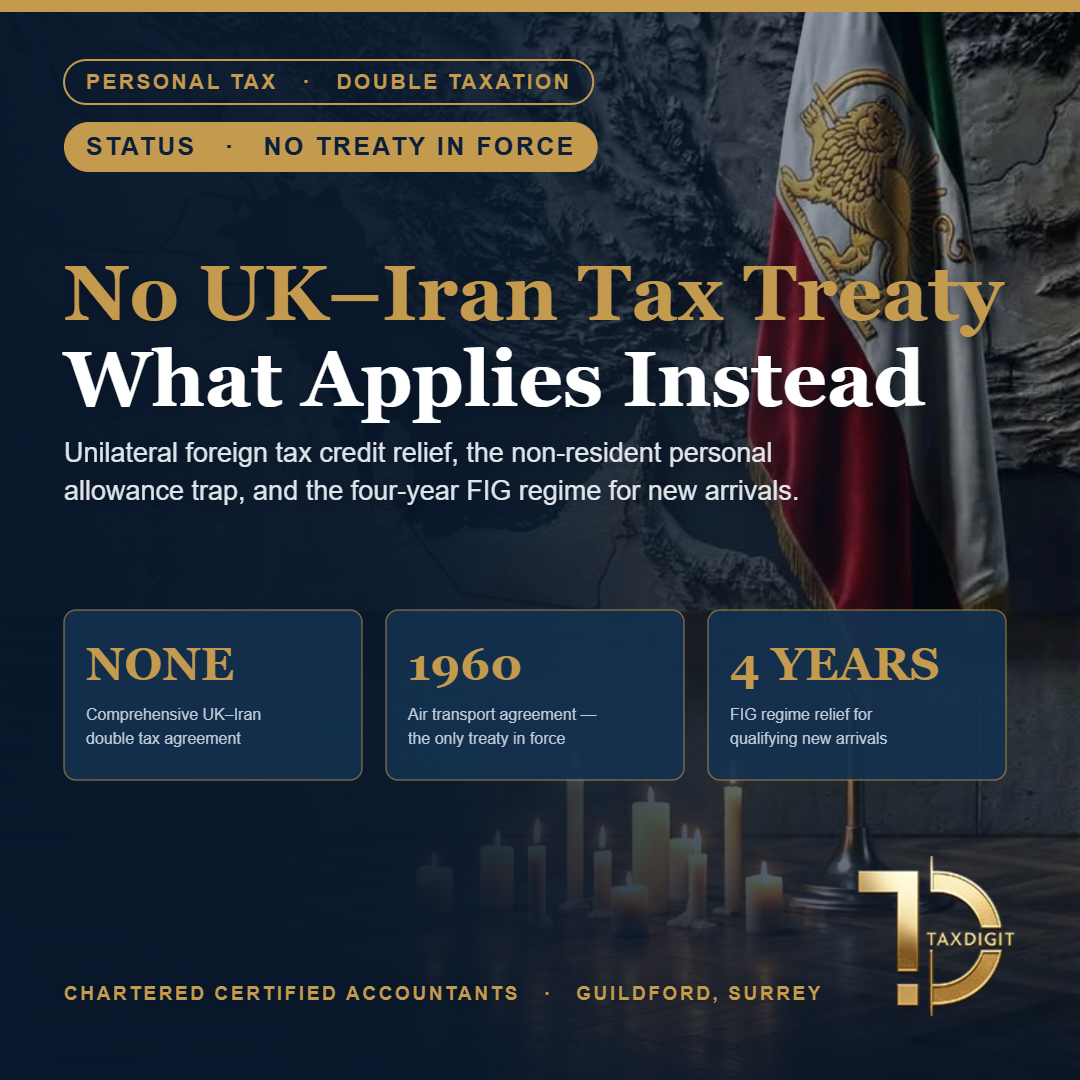
GOV.UK does list an entry for Iran in its tax treaties collection, which misleads a great many people who go looking. The only document behind that entry is the UK–Iran Air Transport Agreement of 1960 (SI 1960/2419), in force since 9 April 1960 and having effect from 1 January 1957. It deals with the profits of air transport undertakings and nothing else, and HMRC’s guidance confirms it does not provide for tax credit.
The practical consequences are these. There is no treaty article allocating taxing rights between the two countries. There are no reduced rates of withholding tax on Iranian dividends, interest or royalties. There is no residence tie-breaker to resolve a case where both countries treat you as resident. And there is no non-discrimination article. Everything falls back on UK domestic law.
Unilateral Relief Is What You Get Instead
UK domestic law does not leave you exposed to full double taxation. Part 2 of the Taxation (International and Other Provisions) Act 2010 provides unilateral relief: where you have paid Iranian tax on income or gains arising in Iran, you can credit that tax against the UK tax on the same income. The credit is capped at the UK tax due on that income, so if the Iranian rate is higher than the UK rate the excess is simply lost — there is no refund and, without a treaty, no mutual agreement procedure to argue about it.
Where a credit is worth little — for example because the UK tax on that slice of income is nil — the alternative is relief by deduction: treating the foreign tax as an expense and taxing only the net amount. It is often the better answer for smaller amounts of Iranian rental income, and it is a choice, not an automatic default. Whichever route you take, keep the Iranian assessment or withholding evidence. HMRC asks for it, and reconstructing it years later from Tehran is not a pleasant exercise.
The Personal Allowance Trap for Non‑Residents
This is where the absence of a treaty bites hardest, and it catches people out constantly.
If you are UK resident, your nationality is irrelevant — you get the personal allowance (£12,570 for 2026/27) like anyone else. If you are non‑resident, though, you only get it if you fall into one of the categories listed in section 56 of the Income Tax Act 2007. Those categories include British citizens and nationals of EEA states. They also include anyone entitled to it under a double taxation agreement — and that is precisely the route that does not exist for Iran.
So a non‑resident Iranian national who does not also hold British or EEA citizenship, and who does not fall into another listed category, has no entitlement to the UK personal allowance at all. Every pound of UK rental profit is taxable from the first pound. Many of our clients are dual British–Iranian nationals and are unaffected; those who are not should assume the allowance is unavailable until it is checked. Non‑residents who are entitled claim it after the end of the tax year on form R43.
The Four‑Year FIG Regime — and What It Costs You
The remittance basis was abolished for all UK residents from 6 April 2025 and replaced by the four‑year Foreign Income and Gains regime. The eligibility test is refreshingly simple: you must be UK resident, within your first four years of UK residence, following at least ten consecutive tax years of non‑residence. Nationality and domicile are irrelevant, and so is whether you could ever have used the remittance basis.
Claimed successfully, it takes qualifying foreign income and gains — Iranian rental profits, Iranian dividends and interest, qualifying foreign gains — out of UK tax for that year. But it is claimed year by year, and it is not free. For any year you claim it you forfeit the personal allowance and the capital gains annual exempt amount (£3,000 for 2026/27), along with the married couple’s and blind person’s allowances. Foreign employment earnings are outside the regime altogether; those are dealt with under Overseas Workday Relief, which for FIG claimants is capped at the lower of £300,000 or 30% of qualifying employment income.
The arithmetic therefore turns on how much foreign income you actually have. For a client with modest Iranian rental income, giving up the personal allowance can cost more than the relief saves. It is a calculation, not a default.
One Deadline Worth Marking
If you were previously taxed on the remittance basis and still hold unremitted pre‑6 April 2025 foreign income and gains, the Temporary Repatriation Facility lets you designate those amounts and bring them into the UK at a flat rate. The rate is 12% for 2025/26 and 2026/27, rising to 15% for 2027/28, after which the facility closes for good. The designation for 2026/27 is made through your Self Assessment return.
2026/27 is the last year at 12%. If this applies to you, it is the most time‑sensitive decision on this page.
What Iranian Clients Should Do Now
- Establish your UK residence position under the Statutory Residence Test before assuming anything — it counts days and ties, and it takes no notice of your visa.
- If you are non‑resident and not a British or EEA national, check your personal allowance position rather than assuming it applies.
- Gather evidence of any Iranian tax paid, and keep it. Without it, a foreign tax credit claim is difficult to sustain.
- If you arrived in the UK within the last four years after a decade abroad, model the FIG regime properly against the allowances it costs you.
- If you hold unremitted pre‑April 2025 foreign income, decide on the Temporary Repatriation Facility before the 12% rate becomes 15%.
Frequently Asked Questions
Is there a tax treaty between the UK and Iran?
Not a comprehensive one. HMRC confirms there is no comprehensive double taxation agreement between the UK and Iran. The only instrument is the 1960 Air Transport Agreement, covering the profits of air transport undertakings, which does not provide for tax credit relief.
Will I be taxed twice on my Iranian rental income?
Not usually. Unilateral relief under TIOPA 2010 lets you credit Iranian tax paid against the UK tax on the same income, capped at the UK tax due. Where a credit is worth little, relief by deduction may give a better result. You need evidence of the Iranian tax paid either way.
Do Iranian citizens get the UK personal allowance?
If you are UK resident, yes — nationality does not matter. If you are non‑resident, you only qualify through one of the categories in section 56 ITA 2007, such as British citizenship or EEA nationality, or through a double taxation agreement. Because there is no UK–Iran agreement, a non‑resident Iranian national without another qualifying status is not entitled to it.
I moved to the UK last year. Should I claim the FIG regime?
Only if the maths works. It removes qualifying foreign income and gains from UK tax for up to four years, but each year you claim it you lose your personal allowance and your capital gains annual exempt amount. With modest foreign income the allowances are often worth more than the relief.
How TaxDigit Can Help
We advise Farsi‑speaking clients on exactly these questions every week: residence and split‑year positions, foreign tax credit claims, whether the FIG regime is worth claiming, and how Iranian property and business interests sit alongside a UK return. You can find more on our international and expat tax, personal tax and non‑resident landlord pages, and Farsi‑speaking support through our Iranian accountant in London service. HMRC’s own confirmation of the position is in its Double Taxation Relief manual at DT9750.
Everything can be discussed in Farsi. All filings and HMRC correspondence are handled in English by the same team, so nothing is lost between the two.
Plan Ahead With TaxDigit
If you have income, property or a business in Iran and you are living in the UK — or you are about to move — the order in which you do things in your first UK tax year matters a great deal. It is far easier to plan it in advance than to unpick it after a return has been filed. Call 01483 230 777, email info@taxdigit.co.uk, or use our contact page to arrange a conversation.
This article reflects the position as at 2 August 2026 and describes UK tax rules of general application. It is not advice for your circumstances.