
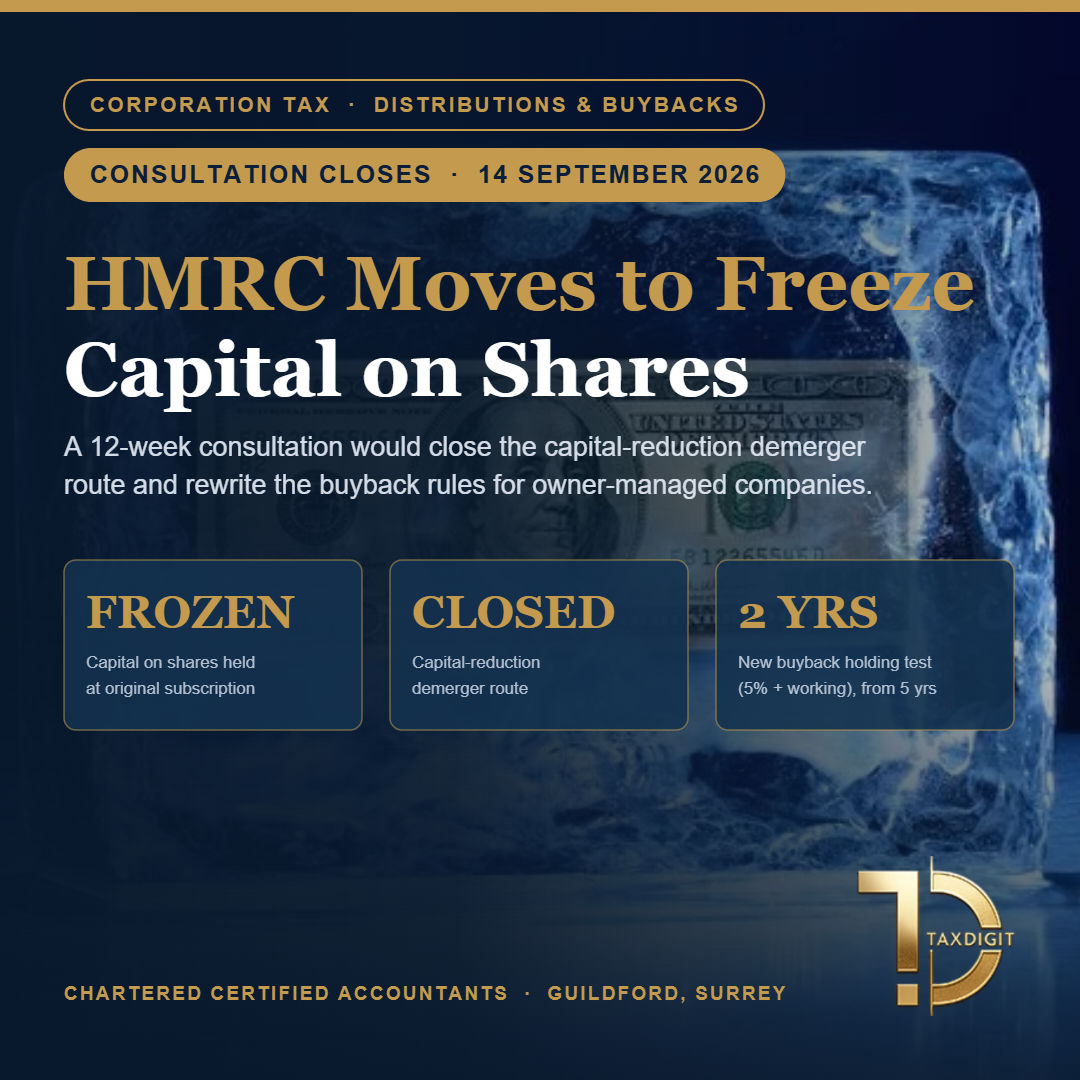
HMRC wants to freeze — and it means that literally. A consultation opened on 23 June 2026 and closing on 14 September 2026 proposes to “freeze” the capital on shares at the amount originally subscribed, a change that would shut down the capital-reduction demerger route entirely and rewrite the rules for a company purchase of its own shares. As chartered certified accountants in Surrey advising owner-managed businesses across the UK, we set out below what is actually being proposed, who it hits, and why the planning window for succession, exit and reorganisation is open now rather than later.
What Is Being Consulted On — and Why It Matters
The consultation is titled Modernising the taxation of distributions and repayments of capital from companies. HMRC’s starting point is blunt: the rules have remained largely unchanged since corporation tax was introduced in 1965, and the result is that “economically similar payments to a shareholder can be taxed inconsistently”. The proposals are focused on shareholders within the charge to income tax — in other words, owner-managers, family companies and their individual investors. Corporate shareholders are not the target.
The prize at stake is the difference between capital gains tax at up to 24% (with capital losses and Business Asset Disposal Relief potentially in play) and income tax on a dividend, where no such reliefs apply and the effective rate is materially higher. Almost every proposal in the document is an attempt to narrow the circumstances in which value can leave a continuing company at capital rates.
The Freeze: How It Would Work
Today, when a shareholder inserts a new holding company above their trading company under a share-for-share exchange (section 135 TCGA 1992), something odd happens. For CGT the base cost carries over — it stays at the original subscription price. But for the distributions rules in section 1000(1)B CTA 2010, the “new consideration” on the new holding company’s shares is the market value of the trading company at the time it was transferred in, including share premium. A £100 subscription can become £2 million of capital on the shares overnight.
HMRC works the point through with an example. A founder who subscribed £100, built the business to £2 million, inserted a holding company, and later extracted £2 million by reducing capital, would currently pay income tax on £1,000,000 and CGT on £999,950. Under the proposal, the capital on the shares would be “frozen” at the original amount subscribed — £50 on a half-reduction — leaving £1,999,950 chargeable to income tax and a nil capital gain.
The stated aim is symmetry: if CGT defers the base cost, the distributions code should defer the capital too. HMRC expects this to “reduce the significance of the TIS rules” by producing the right answer mechanically, without needing to prove a tax-advantage purpose.
The Casualty: Non-Statutory Demergers
The freeze is not aimed at demergers, but it kills them by collateral damage. Capital-reduction demergers — and liquidation demergers under section 110 of the Insolvency Act 1986 — work precisely because a new holding company is interposed and the enlarged capital is then reduced. Freeze the capital and the mechanism stops working. HMRC accepts this directly: the proposal “would remove the capital reduction route used by corporate businesses to carry out non-statutory demergers, increasing reliance on the statutory route”.
In compensation, the statutory demerger relief in Chapter 5 Part 23 CTA 2010 would be liberalised. The government is considering, among other things:
- Removing Condition A, so the companies need no longer be UK or EU resident.
- Widening Condition B to include investment companies — most references to “trade” would be expanded to “activity”.
- Relaxing Condition D’s prohibition on onward sale and on a change of control, so that each becomes a five-year restriction rather than an absolute bar. HMRC expressly says the change-of-control easement is intended “to allow for better succession planning” in family businesses.
- Allowing the distributing company to be dissolved after the distribution under Condition K, provided it holds no assets.
- Removing Conditions C, G, L and M as redundant.
There is a sting. In exchange for the relaxation, the government proposes “to remove the right to apply for automatic appeal by Tribunal should a clearance request be denied”. Wider gateway, but HMRC’s clearance decision becomes much harder to challenge.
Purchase of Own Shares: The Trade Benefit Test Goes
For owner-managed companies buying out a departing shareholder, this is the most consequential section. The subjective “trade benefit test” in Condition A (section 1033(2) CTA 2010), and the Statement of Practice 2/82 practice built around it, would be replaced by “a more mechanical set of requirements”. Under consideration:
- A minimum 5% holding, held for at least two years — down from the current five — and the shareholder must have worked for the company throughout.
- A complete exit: all shares surrendered and all directorships resigned. No retaining a token holding for sentimental reasons. The current 25% substantial-reduction test disappears.
- Multi-tranche buybacks permitted, provided the shareholder fully exits within two years.
- The company must take reasonable steps to ensure the price does not exceed market value.
- Where family connections with remaining shareholders or directors persist, the holding and working period extends to five years.
- A five-year clawback: if the departed shareholder returns as a director or shareholder within five years, capital treatment is withdrawn and income tax is charged in the original year of departure.
Condition B (buybacks to fund an inheritance tax liability, section 1033(3)) is untouched.
Who Should Pay Attention — and Who Should Not Panic
The people who should read this consultation carefully are owner-managers with a succession, exit or reorganisation in contemplation over the next two to three years; family companies where a shareholder wants out but relatives remain; groups planning a demerger to separate trading and property interests; and anyone who has already inserted a holding company and assumed the enlarged capital would be available on a future return of value.
Equally, nobody should reorganise a business purely on the strength of a consultation. There is no draft legislation, no commencement date and no transitional rule in the document. HMRC has said it will “only move forward with these proposals after consultation where doing so is in line with the government’s objectives”. What has changed is the risk profile: the direction of travel is now on the record, and a transaction that is straightforward today may not be in eighteen months.
What Owner-Managed Businesses Should Do Now
- Bring forward planned buybacks and demergers where the commercial logic already exists. If a shareholder exit or a demerger was going to happen anyway, the case for doing it under the current rules is now materially stronger.
- Re-test any planned buyback against the proposed conditions. A shareholder who holds less than 5%, has never worked in the business, or intends to keep a few shares would fail the new test but may pass the old one.
- Review existing holding-company structures. Work out what capital would be treated as frozen and what that would cost on a future return of value.
- Model the statutory demerger route. If it is going to become the only route, find out now whether your group can satisfy the conditions — and get clearance while the Tribunal appeal right still exists.
- Respond to the consultation. Responses go to distributionsreform@hmrc.gov.uk by 14 September 2026, and partial responses on the aspects that affect you are expressly welcomed.
Frequently Asked Questions
When does the HMRC distributions consultation close
The consultation opened on 23 June 2026 and runs for 12 weeks, closing on 14 September 2026. Responses go to distributionsreform@hmrc.gov.uk.
Would the freeze on capital apply retrospectively to existing holding companies
The consultation contains no draft legislation, no commencement date and no transitional or grandfathering rule. That is precisely the uncertainty: an existing structure could find its capital frozen for the purposes of a future return of value, so it is worth quantifying the exposure now.
Are capital-reduction demergers still available today
Yes. Nothing has changed in law. The proposal would remove the route, but it is only a proposal at this stage, and it is one HMRC expects to be contentious.
Does this affect corporate shareholders or listed companies
The consultation is focused on shareholders within the charge to income tax and states that the proposals “are not intended to affect corporate shareholders directly”. The purchase of own shares proposals apply to unquoted trading companies.
How TaxDigit Can Help
Reorganisations, buybacks and demergers are exactly the transactions where a good idea and a bad idea look identical until someone reads the legislation. Our Guildford-based team advises owner-managed companies on shareholder exits and group restructuring, models the tax outcome of a buyback under both the current and the proposed conditions, and handles HMRC clearance applications. Our corporation tax and tax advisory and planning services work alongside our statutory accounts team so the transaction and the reporting line up. The consultation document itself is published as Modernising the distributions framework on GOV.UK.
Plan Ahead With TaxDigit
If succession, an exit or a reorganisation is anywhere on your horizon, the sensible response to this consultation is not to wait for the outcome — it is to work out what the current rules give you and whether you want to use them. As premier accountants in Surrey serving clients across the UK, TaxDigit will map the options against both the law as it stands and the law as it may become. Call 01483 230 777, email info@taxdigit.co.uk, or visit our contact page for bespoke advice.